
The past 18 months have seen a resurgence in the real estate industry, with developers regaining the ground lost to the Covid-19 pandemic. But it is once again adding inventory at a pace faster than sales. The industry's inventory rose by 28 per cent year-on-year (Y-o-Y) in H1FY24, com-pared to a 25.5 per cent year-on-year increase in net sales during the same period.

Joy Thomas stated that one large account -- HDIL -- was the sole reason for the present crisis that led to the regulatory action on Tuesday when Reserve Bank of India superseded its management and placed it under an administrator for the next six months.
He also affirmed that over time, as the government finances improve, the SLR will be brought down further.

Calling out the high real interest rates -- the differential between the policy rate and headline inflation -- as an impediment to investment, the SBI report said the RBI can cut rates by 0.35-0.50 per cent at its next policy announcement.

'As our per capita income increases and various demographic segments emerge, the need for various kinds of protection and risk covers will become even more explicit.'

According to the Icra report, earnings before interest, tax, depreciation and amortisation margin of its sample declined by 44 basis points on a YoY basis and 23 basis points on a quarter-on-quarter basis to 16.6 per cent.


The problem is actually acute in the diamond jewellery industry where there is no uniform criteria of inventory valuation unlike gold, whose prices are uniform and widely quoted.

After hiking the repo rate by 0.50 per cent, RBI Governor Shaktikanta Das on Wednesday said future policy actions by the central bank will be guided by the evolving conditions. Addressing a press conference, the governor said the RBI has changed the policy stance to drop the phrase "remains accommodative", and instead opted for "withdrawal of accommodation" for guiding its future moves. The central bank did not hike the cash reserve ratio contrary to speculation, he said, adding that the liquidity withdrawal will be calibrated and measured.

The second wave of the coronavirus pandemic is likely to delay recovery in air passenger traffic with an 80-85 per cent growth year-on-year this fiscal against the earlier estimate of 130-135 per cent, ratings agency ICRA said on Monday. The domestic passenger traffic, which witnessed a steady ramp-up after resumption of airport operations since May 25 last year and reached 64 per cent of the previous year levels in February, has again suffered a setback, the ratings agency said in a report. The spike in coronavirus infections towards March-end and April has resulted in several state governments implementing fresh restrictions, resulting in a marginal 0.7 per cent de-growth sequentially in traffic in March.

RBI Governor Shaktikanta Das kept the red flag on cryptocurrencies flying, warning that the next financial crisis can be triggered by private cryptocurrencies if such speculative instruments are allowed to grow.

Standalone total income increased to Rs 74,457.86 crore in the first quarter of 2020-21, from Rs 70,653.23 crore in the same period a year ago.

While margins contracted by 30 basis points on y-o-y basis, they fell a sharper 120 basis points on a sequential basis to 16.8 per cent. Profitability was impacted adversely due to subdued demand, tepid realisations in commodity sectors, and negative operating leverage.

Governor Urjit Patel and his deputies spoke to the media about the central bank's decision to raise the repo rate.

M-cap of 35% of BSE-500 companies, excluding financial ones, is below their debt or just a shade above

A term plan's premium is lower than that of a wholelife plan.

With the international markets facing uncertainty after Russia invaded Ukraine and Western nations retaliated with sanctions, Indian companies are putting their international fundraising plans on hold as they wait for the markets to recover. Bankers said apart from the geopolitical crisis, international rates are hardening in anticipation of interest rate hikes by the US Federal Reserve to control rising prices in the US. The Ukraine situation has implications for the market. In such a situation, international investors try to shift to safe haven assets by exiting from emerging markets.

Amid slowdown blues, the government has unveiled a raft of measures over the past few months aimed at improving liquidity in the system, moderating interest rates as well as credit growth apart from addressing stress in the NBFC sector.

Axis Bank and ICICI Bank consumed 37-59 per cent of their operating profit for COVID-19 provisioning, while the figure is 24 per cent in case of Kotak Mahindra Bank and 10-12 per cent for IndusInd Bank and HDFC Bank.

For development finance institution to succeed now, the government must stand like a rock behind it and be patient.

Thanks to the recapitalisation by the government and measures taken by the central bank, collapse of any large housing finance company won't pose as big a risk as it had six months ago.

Corporate indebtedness is now twice what it was before the global financial crisis; banks' bad loans ratio is 3.5 times higher.

Share prices of Dewan Housing, Indiabulls Housing, and PNB Housing have declined 30-80% in the past one year

Merely bringing down the government stake below 51% may not find any taker for the PSBs. The government must bring down its holding to at least 26%, recommends Tamal Bandyopadhyay.
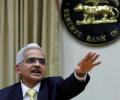
'The banking sector appears to be on course to recovery,' declares the RBI governor.

The following are the highlights of the mid-term review of Monetary and Credit Policy for the year 2003-04.
Leeway on CRR and SLR was a long-standing demand from banks, which the RBI did not agree to till recently.

'We are very watchful about inflation and growth. But the main challenge is economic revival and growth.'

There are also signs that the private sector investment cycle is slowly coming back, as capacity utilisation figures across industry continue to slowly creep up. A pickup in investments will front load profitability, says Akash Prakash.

Exposure to debt funds and gold is essential even if current returns from these asset classes are low, suggests Sanjay Kumar Singh.

Though most experts remain bullish on the banking space, they suggest investors buy only those banks whose NPAs are at a manageable level of 3% to 4% and there is credit growth or earnings visibility.

Stocks might hit new highs even before B-Day.

The cut in the policy rate by RBI will help lower interest rates

India's banks rely on overnight borrowings to fund longer-term lending.

The choice clearly is between prompt corrective action and slow but sure destruction, says Tamal Bandyopadhyay.

'Let's walk on two legs: Facilitate better resolution under the present system and set up PARA as well by transferring loans amounting to, say, Rs 1 lakh crore.'

Overall, the credit profiles of players will be supported by healthy balance sheets and liquidity. Prudence in capital and development expenditure, efficient working-capital management, and recent equity raising will help sustain credit metrics in FY22.
'Every few days, I wake up with a sense of restlessness that time is running out'... 'We have created a due process for stressed assets to resolve, but there is no concrete plan in place for public sector bank balance sheets,' says RBI Deputy Governor Viral Acharya.

The trust deficit has widened with buyers losing confidence in a developer's ability to construct and deliver a project on time.
.jpg)
The right sequence would be to gradually reduce SLR
